How Cold Does It Get in Cochrane?
How cold does it get in Cochrane, Alberta? The 30-year numbers for cold, snow and wind, how chinooks break the cold, what the roads are like, and what winter means for a home.
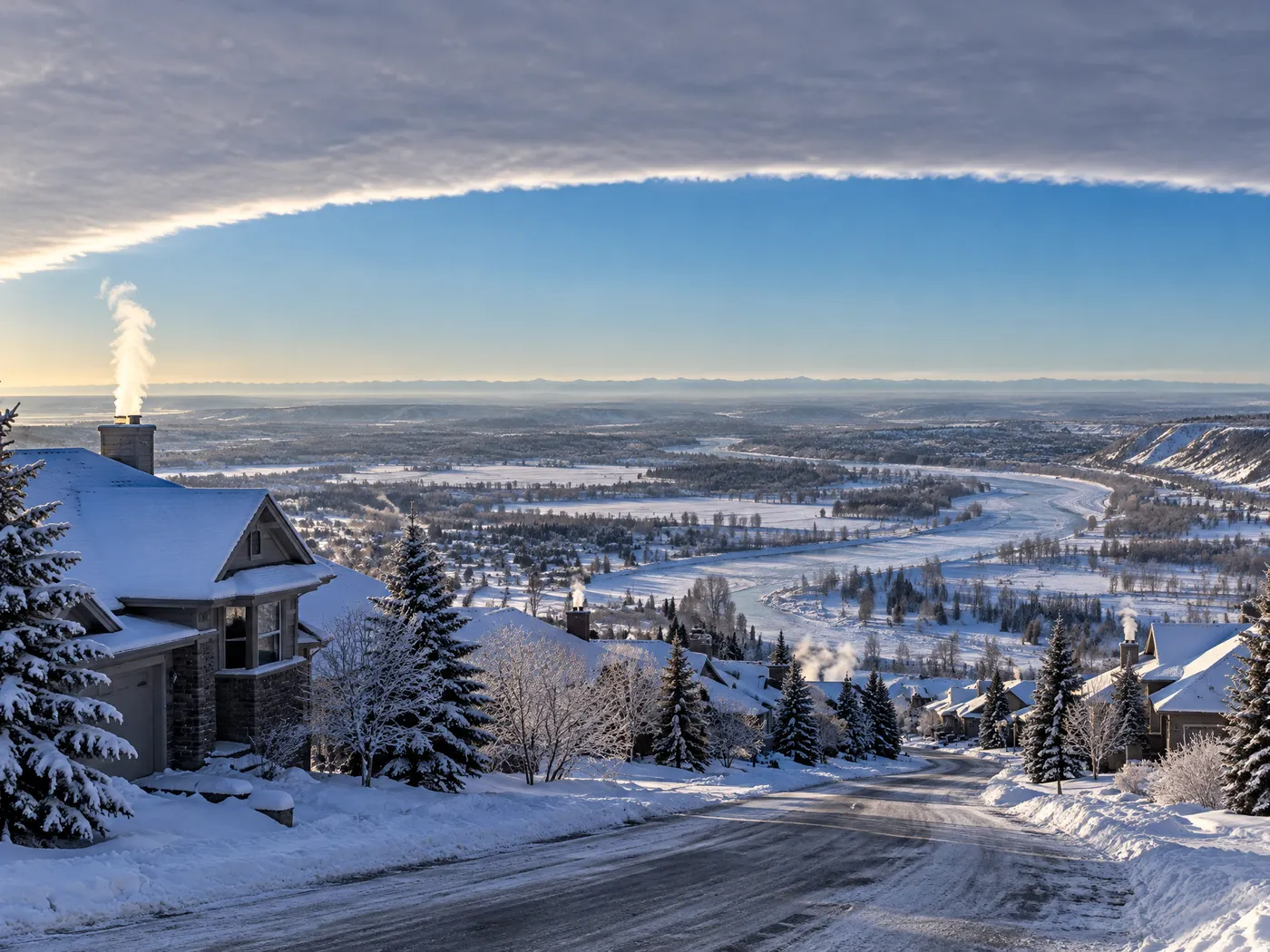
How cold does it get in Cochrane? January averages −7.6 °C, with typical overnight lows of −13.5 °C, at Calgary International Airport, the nearest station with official 1991–2020 normals (Environment and Climate Change Canada). Nights below −20 °C come about 22 times a year and below −30 °C about three times. Cochrane sits higher, so treat these figures as approximate.
- 01About 138.7 cm of snow falls in an average year (Calgary Airport normals, 1991–2020), and March, not January, is the snowiest month at 23.8 cm.
- 02The coldest reading of the 1991–2020 normal period was −39.7 °C on 11 Jan 1997; the long-term record is −45.0 °C in February 1893.
- 03About one winter day in three in southwest Alberta is a chinook day (The Canadian Encyclopedia), so cold spells are often broken by mild days.
- 04Alberta does not require winter tires, but Alberta Transportation recommends four winter or all-weather tires for severe conditions.
- 05The Town plows once 3 cm has built up, emergency routes and arterials first; residential intersections are sixth on the list.
How cold does it get in Cochrane, Alberta? Milder than Edmonton, probably a touch colder than the Calgary figures, and far less steady than either: a few nights each winter fall below −30 °C, and a warm chinook wind can then push the afternoon above freezing within hours. Below are the official 30-year numbers, the snow and wind, how the Town clears the roads, and what it all means when you choose a home, as part of our wider guide to living in Cochrane.
How cold does it get in Cochrane? The 30-year numbers
Expect January days around −1.5 °C and nights around −13.5 °C, with cold snaps well below that. Those are the 1991–2020 Canadian Climate Normals for Calgary International Airport, from Environment and Climate Change Canada (ECCC). No station in Cochrane or at Springbank Airport has official normals, so the airport is the nearest reliable 30-year record.
- January daily average
- −7.6 °C
- Calgary Airport normals, 1991–2020
- Nights below −20 °C
- 21.6 a year
- 7.7 of them in January
- Coldest reading, 1991–2020
- −39.7 °C
- 11 January 1997
- Annual snowfall
- 138.7 cm
- Spread over about 55 snow days
The cold comes in spells rather than seasons. Only 4.7 days a year stay at or below −20 °C all day, while January also averages 2.5 days above 10 °C. Environment Canada's Cochrane forecast uses conditions "observed at Springbank Airport", and Cochrane sits higher than the airport station (1,099 m), so treat every figure here as a close approximation.
Cochrane weather in winter, month by month
Winter runs from November to April, with the deepest cold in December and January and the heaviest snow in March and April (ECCC, Calgary Airport, 1991–2020).
| Month | Daily high | Daily low | Snowfall | Nights below −20 °C |
|---|---|---|---|---|
| October | 11.1 °C | −1.3 °C | 11.5 cm | 0.1 |
| November | 4.1 °C | −7.5 °C | 18.8 cm | 1.7 |
| December | −0.4 °C | −12.1 °C | 16.3 cm | 4.6 |
| January | −1.5 °C | −13.5 °C | 16.6 cm | 7.7 |
| February | 0.1 °C | −11.8 °C | 16.9 cm | 4.8 |
| March | 3.8 °C | −8.1 °C | 23.8 cm | 2.7 |
| April | 10.8 °C | −1.9 °C | 22.9 cm | 0.0 |
| May | 16.4 °C | 3.4 °C | 9.6 cm | 0.0 |
These are averages of days that swing between bitter and mild, so a "−1.5 °C" January can mean a week at −25 °C followed by a week at +8 °C. The average last spring frost is 21 May, and the first fall frost arrives around 18 September.
How much snow does Cochrane get?
About 138.7 cm a year at the Calgary Airport station, and Cochrane, higher and closer to the foothills, may get a little more. It arrives in many small falls: about 55 days bring measurable snow, but only about eight bring 5 cm or more.
Chinooks keep it from piling up, and average January snow depth at the airport is just 5 cm. Big storms come mostly in spring: the heaviest single day of the normal period was 32.2 cm on 26 April 2003.
How the Town clears it
The Town starts plowing once about 3 cm has built up. Crews do emergency routes first, then arterials, collectors, designated hills, the industrial area and, sixth, residential intersections with bigger roads. Town sidewalks and pathways are cleared within 48 hours, and residents can collect a free sand and salt mix at the Matt Krol sports field lot, 245 Riverview Drive.
Residential streets are not on the Town's plow priority list; only their intersections with bigger roads are, and they come sixth. A steep crescent can stay snow-packed after the main roads are clear. The Town also notes that road salt "is not effective below −10 C", which covers most January nights.
Chinooks: why winter comes in waves
A chinook is a warm, dry, gusty westerly that drops down the eastern slopes of the Rockies and warms as it descends. In southwest Alberta about one winter day in three is a chinook day, according to The Canadian Encyclopedia, which also records a rise of 27 °C in two minutes. The trade-off is ice: snow melts on roofs, driveways and roads in the afternoon and refreezes overnight.
Clear the driveway on the mild chinook afternoon, not the next morning. Meltwater on a sloped driveway refreezes overnight, and salt stops working below −10 °C, so keep a bucket of the Town's free sand and salt mix by the door.
Is Cochrane colder than Calgary, Banff or Edmonton?
Cochrane is probably a little colder than the Calgary Airport figures and much milder than Edmonton. No Cochrane normals exist, so the table uses three official stations (ECCC, 1991–2020).
| Station (elevation) | January average | January low | Annual snowfall | Days with wind chill below −20 |
|---|---|---|---|---|
| Calgary Airport (1,099 m) | −7.6 °C | −13.5 °C | 138.7 cm | 42.0 |
| Banff (1,397 m) | −8.5 °C | −13.5 °C | 183.8 cm | 39.1 |
| Edmonton Airport (723 m) | −12.3 °C | −18.1 °C | 126.7 cm | 67.4 |
Chinooks thin out away from the mountains, to about one winter day in five in northeast Alberta. Banff matches Calgary's overnight lows but gets about a third more snow, and Cochrane sits between the two.
Wind, the part people mention
The airport averages about 21 days a year with winds of 52 km/h or more and 14.5 days with a wind chill below −30. The Government of Canada rates a wind chill of −28 to −39 as high risk, when exposed skin can freeze in 10 to 30 minutes. Our guide to is Cochrane a good place to live puts winter alongside the town's other trade-offs.
Winter driving on Highway 22 and the 1A
Cochrane sits in the Bow Valley, so most trips start or end on a grade, whether Highway 22 heading north toward Sunset Ridge or a sloped residential street. The Highway 1A/22 interchange was completed in summer 2026, so the old bottleneck is gone, but the grades remain. Heritage Hills, north of Highway 1A and west of Highway 22, is a hillside community too: its West Hawk phase was marketed on views over the town to the west and south (JL Developments, 2023).
Fit four winter or all-weather tires
Alberta has not mandated winter tires, but Alberta Transportation recommends four for severe conditions. Look for the peaked-mountain-and-snowflake symbol.Pack a winter kit
A blanket, spare clothing, a shovel, booster cables, an ice scraper, a flashlight, food, and sand or non-clumping kitty litter for traction.Triple your following distance
On slick roads the province advises at least three times the normal gap, and to stay back from snowplows.Know your backup
The On-It bus ended in June 2026. Falcon Bus runs five weekday trips each way to Calgary, useful on a bad driving day.
For drive times, routes and the bus timetable, see our guide to Cochrane to Calgary.
What winter means for buying a home in Cochrane
Winter should shape which home you buy, not just how you dress.
- Garage and driveway. An attached garage saves scraping on −25 °C mornings. A steep north-facing driveway can stay icy long after a chinook has cleared a south-facing one across the street.
- Hills. Hillside and river-valley streets give the views but sit last in the plow order. In Precedence, the third stage of Riversong, the larger homes line the escarpment above the Bow River, and the Town's plan rules out a direct road to James Walker Trail because of the drop. Drive the street after a snowfall if you can.
- Heating and envelope. Calgary Airport logs about 4,994 heating degree days a year. A new home comes with Alberta's mandatory warranty, which covers the building envelope for five years; weigh that against an older home's insulation and windows using our guide to choosing a new build or a resale home. ATCO Gas's default energy rate moved from $3.331/GJ in January 2026 to $1.893/GJ in November 2026, before delivery charges; our guide to Cochrane utilities explains the bills.
- Roof and gutters. Repeated melting and refreezing is hard on shingles and eavestroughs. Ask the inspector about the furnace's age, the roof, attic ventilation and insulation.
- Single-level living. Fewer outdoor stairs matter in an icy month, and our guide to bungalows and other single-level homes in Cochrane covers that market.
Winter has its pleasures too: the SLS Centre's four ice arenas, lit rinks at Mitford Pond and Fireside until 10 pm, and ice-boat sailing on Ghost Reservoir (Alberta Parks). Our list of things to do in Cochrane Alberta covers the rest. If a cold snap brings a fall, note there is no Cochrane Alberta hospital: urgent care runs 8 am to 10 pm.
Planning a move around Cochrane winters
Cochrane's winter is real but broken up: a handful of nights below −30 °C, roughly 140 cm of snow that rarely stays deep, and chinooks that turn the weather in hours. The practical costs come from ice, hills and heating, so look at the garage, the driveway's slope, the furnace and the roof from the first viewing. A local agent can walk the driveway, garage and furnace with you street by street, and help with the question every newcomer asks: how cold does it get in Cochrane, and how will this house cope?
Ask us anything about buying in Cochrane: prices, communities, builders, taxes, or whether a specific home is worth the drive. Free, no obligation.
How Cold Does It Get in Cochrane? Common Questions
Is Alberta, Canada very cold?
It depends where. Calgary Airport, the nearest normals station to Cochrane, averages −7.6 °C in January, while Edmonton Airport averages −12.3 °C and has about 67 days a year with a wind chill below −20, against 42 at Calgary (ECCC normals, 1991–2020). Southern Alberta is colder than coastal Canada but milder than the north, largely because of chinooks.
How cold is too cold to go outside?
The Government of Canada rates a wind chill of −28 to −39 as high risk, when exposed skin can freeze in 10 to 30 minutes, and −40 to −47 as very high risk, with freezing in 5 to 10 minutes. Below −48 the risk is severe. Calgary Airport averages about 14.5 days a year with a wind chill below −30, so cover up and keep trips short on those days.
What is the coldest month in Cochrane?
January. At Calgary Airport, the nearest station with official normals, January averages −7.6 °C with a typical low of −13.5 °C and about 7.7 nights below −20 °C (ECCC, 1991–2020). December is a close second at −6.3 °C. Snowfall peaks later: March brings the most, about 23.8 cm on average.
Is Cochrane colder than Calgary?
Probably a little, but nobody publishes official normals for Cochrane to prove it. The town sits higher than the Calgary Airport station, and Environment Canada's Cochrane forecast uses observations from Springbank Airport, between the two. So treat the airport figures as a close guide rather than a Cochrane measurement. Read Cochrane to Calgary for how that affects the drive.
When does winter end in Cochrane?
Later than newcomers expect. April still averages 22.9 cm of snow at Calgary Airport, and the average last spring frost is 21 May, with the first fall frost around 18 September, leaving a frost-free season of about 119 days (ECCC, 1991–2020). Planting anything tender before late May is a gamble.
Do you need winter tires in Cochrane?
They are not legally required. The Government of Alberta says it has not mandated winter tires, but Alberta Transportation recommends four winter or all-weather tires for severe winter conditions. If you commute on Highway 22 or the 1A, or live on a sloped street, they are worth the cost. Look for the peaked-mountain-and-snowflake symbol, which marks tires that meet a snow traction standard.
- Town of Cochrane, Development Summary Report 2025 (PDF)
- Town of Cochrane, Precedence Neighbourhood Plan
- RENX Homes, JL Developments launches hillside community (11 Aug 2023)
- Government of Alberta, New home warranty overview
- ECCC, Canadian Climate Normals 1991–2020, Calgary (Airport)
- ECCC, Canadian Climate Normals 1991–2020, Banff
- ECCC, Canadian Climate Normals 1991–2020, Edmonton (Airport)
- Environment Canada, Cochrane AB 7 Day Forecast (observed at Springbank Airport)
- The Canadian Encyclopedia, Chinook
- Government of Canada, Wind chill and the Wind Chill Index
- Town of Cochrane, Snow & ice removal
- Government of Alberta, Winter Tires (PDF)
- Government of Alberta, Safer winter highways
- Town of Cochrane, Highway 1A/22 Interchange
- Falcon Bus, Schedules
- Utilities Consumer Advocate, Default rates
- Town of Cochrane, Outdoor recreation
- Town of Cochrane, Trails & pathways
- Government of Alberta, Winter recreation on public land
- SLS Centre, About Us
- Alberta Parks, Ghost Reservoir PRA
- Alberta Health Services, Cochrane Community Health Centre urgent care
Keep reading
 Living in Cochrane, Alberta: The Honest 2026 Guide
Living in Cochrane means a town of about 39,385 people, 35 minutes from downtown Calgary, with no hospital, no commuter train and a typical Town utility bill of $131.86 a month.
8 min read Cochrane to Calgary: Drive Times, Routes, Transit
Cochrane to Calgary in practice: the Town's 35-minute drive time, the finished Highway 1A/22 interchange, the Falcon Bus timetable, the end of On-It, and winter driving.
8 min read Things to Do in Cochrane, Alberta: A Local’s List
Things to do in Cochrane, Alberta are mostly free and close to home: more than 500 hectares of Town parks, six off-leash areas, the Ranche, the Bow River and two golf courses.
12 min read Homes for saleCochrane Bungalows for Sale
Cochrane bungalows for sale start from the low $600s new in Southbow Landing (builders, Nov 2026). Live MLS® listings are not shown here; a REALTOR® has those and the sold prices.
11 min read Cochrane PropertiesCochrane REALTOR® Cory Hand
Cochrane REALTOR® Cory Hand works with buyers and sellers: he checks the community, the builder and the numbers before you view, and prices off real sales.

Schools, the commute, a community, a builder: ask it here and get a straight answer from a licensed REALTOR®. Free, and no obligation.
“Buying or selling your property is a very personal endeavour. Trusting your realtor is paramount. Cory cares about his clients with outstanding professionalism and attention to detail. I would highly recommend him for your real estate needs in Alberta.”
5.0 from 56 Google ratingsCory replies himself: same day during business hours.